NAPLAN-style practice, free for your whole school
Every student, every year level, all four papers - reading, writing, language conventions and numeracy. There's nothing to pay, nothing to subscribe to and nothing to cancel. Set your school up and your classes can start the same day.
No card, no invoice, no minimum and nothing that renews. You'll still create an account so your students have somewhere to sit their papers and you have somewhere to see the results - but there is no payment step anywhere in it.
NAPLAN-Style Practice Tests for Schools
A class that sits the same practice paper twice is measuring memory the second time. That is the problem with a printed booklet: it works once, and after that the marks go up whether or not the learning did.
Litzi assembles every paper at the moment a student sits down, drawing from a bank of thousands of questions against a blueprint that mirrors the structure of the real papers. Questions a student met in recent sittings are held back for them specifically - so thirty students sitting “the same” practice test are sitting thirty different papers, and a class can practise in October and again in February and both results mean something.
It also means a paper cannot circulate. There is no answer key to find, because there is no fixed paper to have a key for.
Free for your whole school
Every year level, every student, right through to NAPLAN 2027. No per-seat counting, no licence, nothing to pay.
There's no catch and nothing to cancel. Create your school account and your classes can start today.
Families can use it at home too, also free. See practice tests for families.
Set Up My School - Free Family Options Sample TestWhat's covered
Original passages - imaginative, informative and persuasive - with literal, interpretive and reflective questions.
Narrative and persuasive prompts, marked against the ten assessment criteria.
Spelling, grammar and punctuation - from homophones and apostrophes to clause analysis.
Number and algebra, measurement and geometry, statistics and probability. Years 7 and 9 include separate calculator and non-calculator papers.
What the real tests look like
The published structure of NAPLAN itself, so you can see what is being prepared for. Our practice papers mirror this shape - they are original questions, not NAPLAN material.
| Domain | Year 3 | Year 5 | Year 7 | Year 9 |
|---|---|---|---|---|
| Reading | 39 questions45 min | 39 questions50 min | 48 questions65 min | 48 questions65 min |
| Writing | 1 prompt40 minpaper | 1 prompt42 min | 1 prompt42 min | 1 prompt42 min |
| Conventions of Language | 52 questions45 min | 52 questions45 min | 52 questions45 min | 52 questions45 min |
| Spelling, then grammar & punctuation | 25 + 27 | 25 + 27 | 25 + 27 | 25 + 27 |
| Numeracy | 36 questions45 min | 42 questions50 min | 48 questions65 min | 48 questions65 min |
| Calculator section | no calculator | no calculator | ✓ second section | ✓ second section |
| Total questions (excl. writing) | 127 | 133 | 148 | 148 |
| Our question pool (live questions available) | 661 | 712 | 897 | 823 |
Every paper is drawn from that pool at the moment a student sits down, and questions they met in recent sittings are held back. A Year 7 student answering 148 questions has 897 to draw from - so a second attempt is a genuinely different paper, not the same one again. We're adding new items to the bank all the time, so the pool grows and the number of unique sittings a student can have increases. No two attempts will be identical, and the more they practise, the more they will see.
Every domain except Year 3 writing is sat online and tailored, so difficulty branches with the student and no two sit an identical paper. Counts are the published test-design specification and can move by an item or two between years. Source: nap.edu.au.
How students access the tests
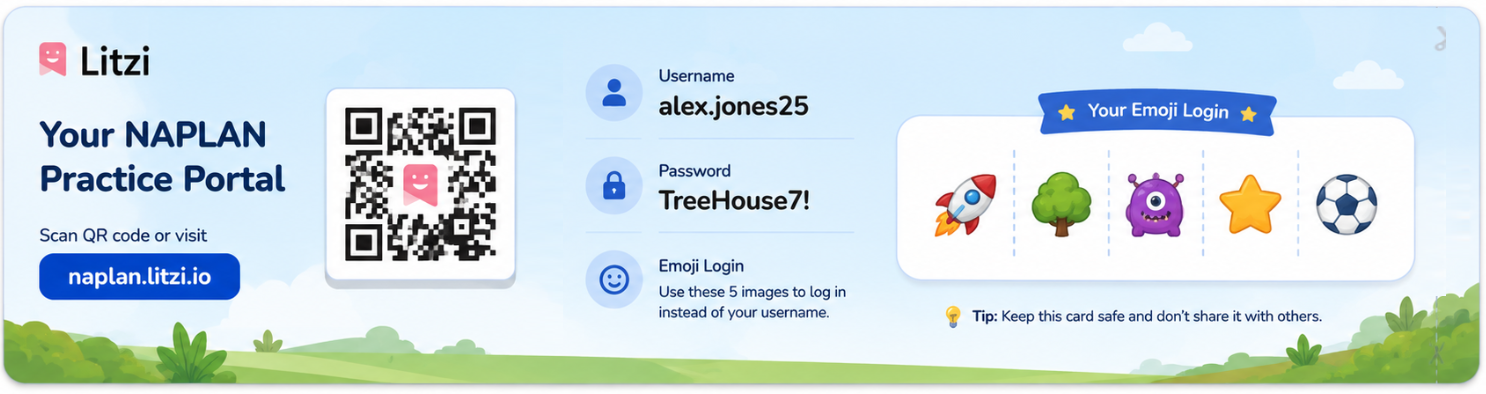
Sitting a paper starts with a student signing in, and in a Year 3 classroom that is the step that actually costs the lesson time. Every student gets a printable access card with everything they need on it — hand them out once and the class can get themselves started.
Older students sign in the usual way, with a username and a password. For younger ones, or any class where typed passwords turn a ten-minute start into a twenty-minute one, each student also gets a unique combination of emoji — they tap their own sequence of pictures instead of typing anything at all. It is quick, it is memorable in a way an eight-character password is not, and a student who cannot yet type reliably is not disadvantaged before the paper has even begun.
Either method signs in the same student to the same account, so a class can use whichever suits and you are not managing two sets of anything.
A closer look at each paper
Four papers, the same four NAPLAN assesses. Here's what your students sit in each.
Reading
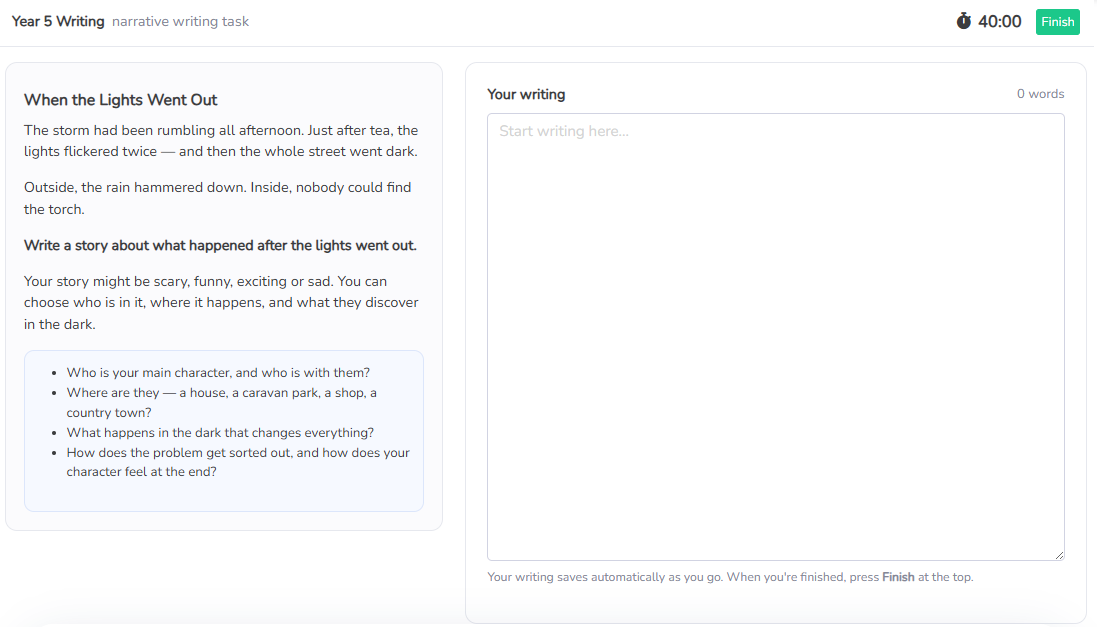
Students read a series of original passages - a story, an article, an argument - and answer questions on each. Passages are written to the year level and set in places an Australian student recognises, and every question is answerable from the text in front of them, so a student is never disadvantaged by not having encountered the topic at home.
Questions work at three levels: locating what the text states, inferring what it implies, and evaluating why the writer made a choice. The balance shifts with the year level - Year 3 leans on retrieval, Year 9 asks far more often what the writer was trying to do to the reader - which is exactly the progression the comprehension strand builds toward. The passage sits beside the questions, and a student who needs larger text scales the passage and the question together.
Writing
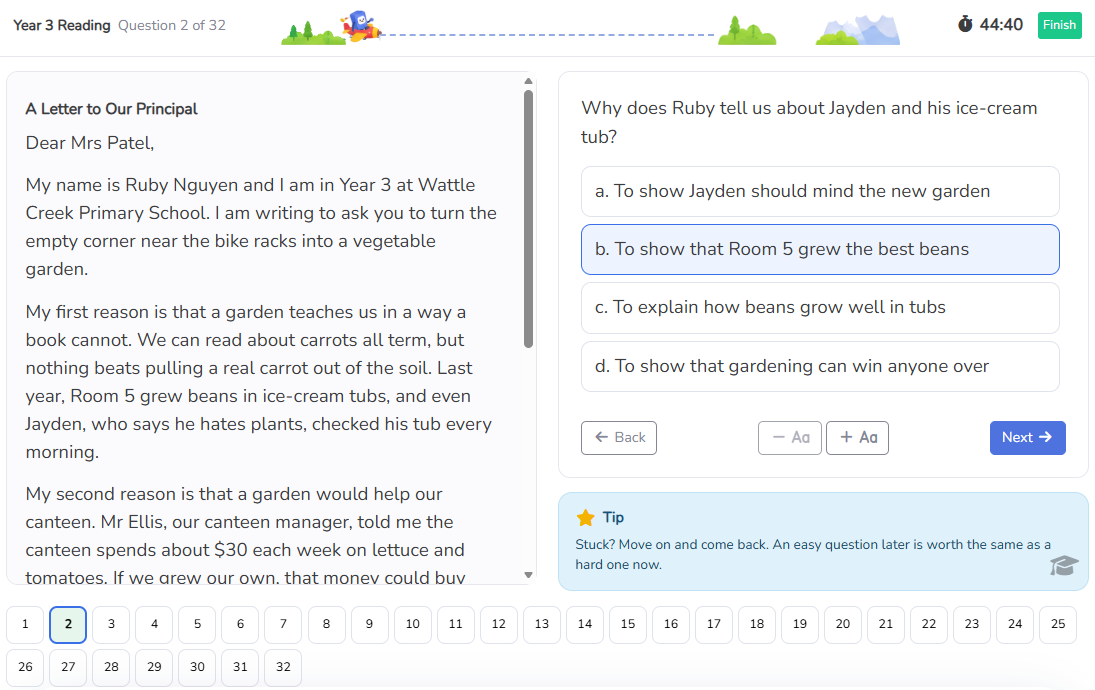
One task, forty minutes. Students are given either a narrative prompt - a starting point to build a story from - or a persuasive one: a proposition with two defensible sides that they have to argue. A short planning scaffold sits above the writing space and a live word count runs beside it, and everything saves as they type, so a dropped connection costs a moment rather than a lesson.
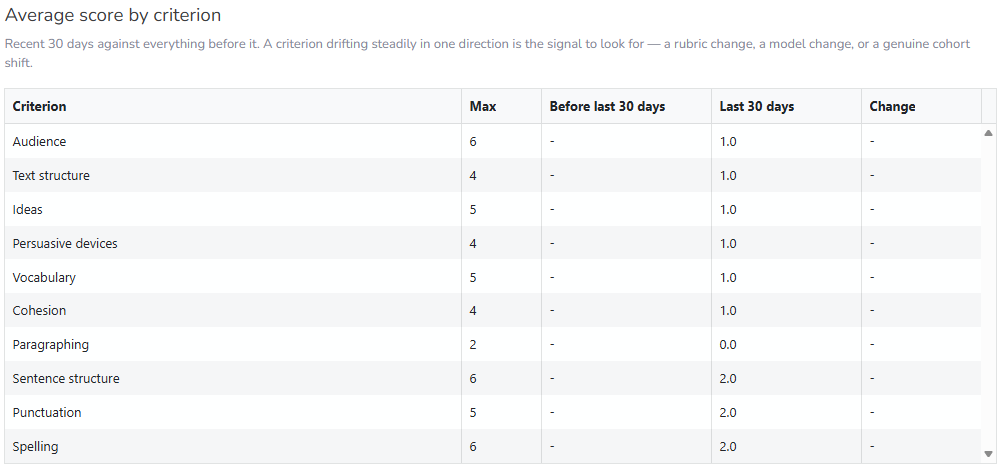
Responses are marked against the ten assessment criteria, from audience and text structure through to paragraphing, punctuation and spelling, with a comment on each rather than a single number. Because spelling and sentence structure carry marks, the browser's own spellchecker and autocorrect are switched off for that box - the work you get back is the student's unaided.
Language Conventions
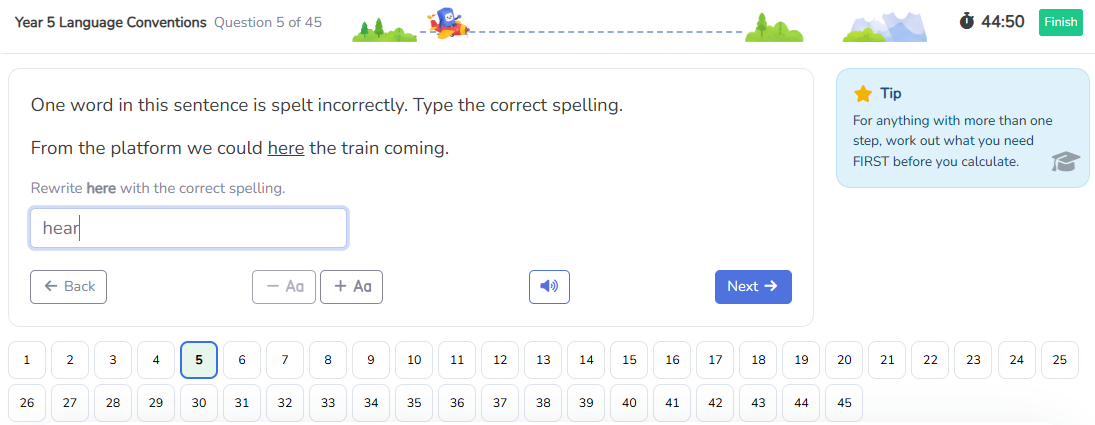
Spelling, grammar and punctuation, in short questions that come quickly. A spelling question shows a sentence with one word underlined and asks for it correctly spelt; a grammar or punctuation question usually offers four versions of a sentence where only one is right. It is the paper where a class's grasp of how written English works either holds up or does not, and it is the fastest of the four to sit.
Coverage widens considerably between Year 3 and Year 9 - homophones, plurals and apostrophes early, then clause structure, modality and the punctuation of complex sentences later. Australian spelling throughout: colour, centre, organise, practise as the verb.
Numeracy
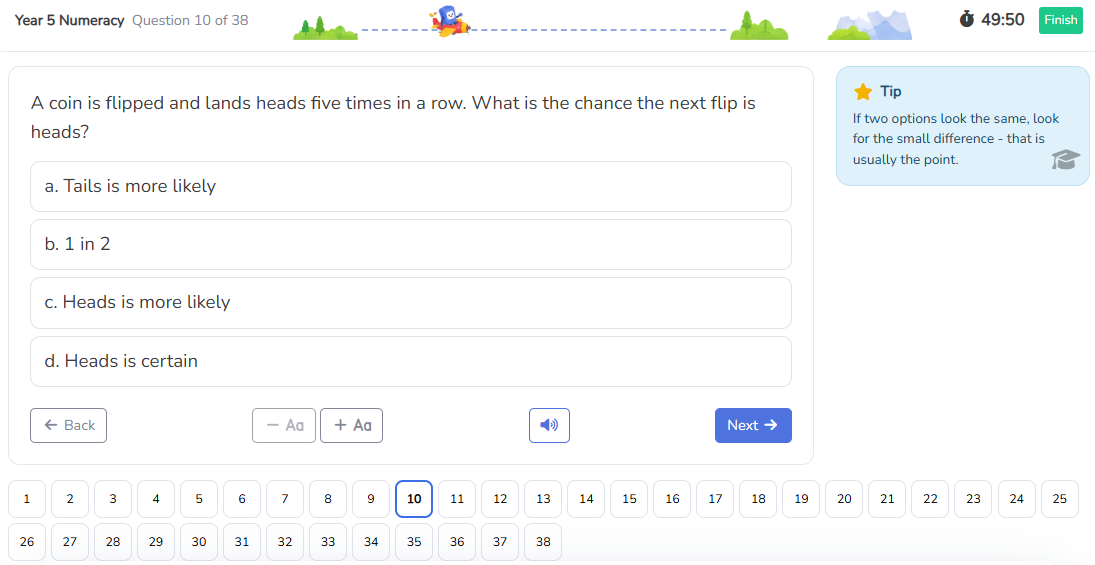
Number and algebra, measurement and geometry, and statistics and probability - fractions and percentages, area and volume, angles, coordinates, reading data from a table, working out how likely something is. Questions are set in situations rather than left bare: a shopping total, a bus timetable, a netball court.
From Year 7 numeracy becomes two separate papers. One is sat without a calculator, where the numbers stay friendly and the skill being tested is the mathematics rather than the arithmetic. The other assumes one, with an on-screen calculator built into the test screen, so a school does not have to supply or supervise devices to run it.
At school and at home
A practice paper runs in a browser, so where a student sits it is entirely up to you. Run a full paper as a timed session in class, under conditions that look like the real thing - or set one for homework, over a weekend, or across the holidays. There is nothing to install and no school network to be on: the login your student already has works from a laptop at the kitchen table.
The two do not collide. Questions a student has recently seen are held back for that student, so a paper sat at home in the evening does not reappear in Tuesday's class session, and a student who has been away can catch up on their own without repeating what the class already did. Untimed mode is the one worth pointing families at: with the clock off, every question opens up its worked solution as soon as it is answered, which turns a practice paper at home into something a parent can actually sit beside their child and use.
All of it is inside the one whole-school licence. Families are not asked to buy anything, and you are not counting seats to work out who gets access at home - every student at your school has it, wherever they are.

Classes & student management
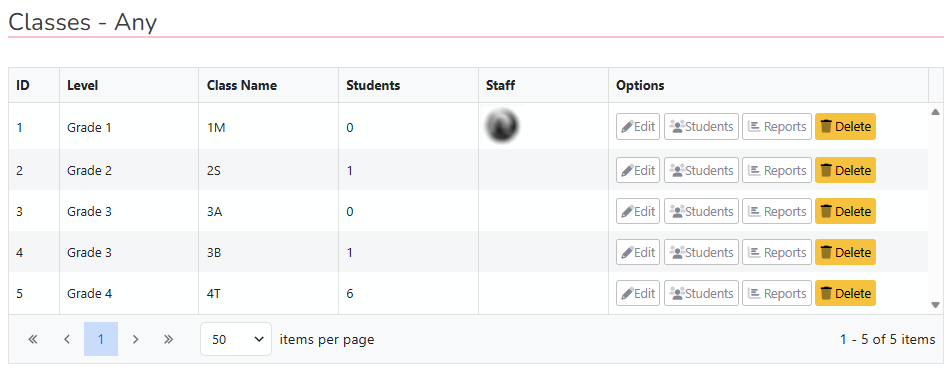
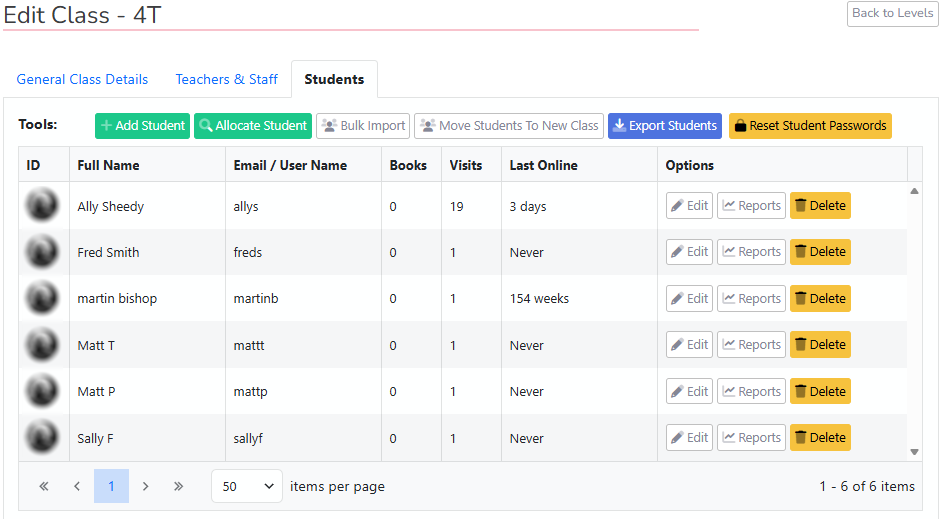
Your school's classes and students are set up once and used everywhere in Litzi. Add a year level, add a class, add the students in it - or bring an existing list across rather than retyping thirty names. Students sign in with the credentials they already have, so a practice paper does not start with a lesson on logging in.
Because the licence is whole-school rather than per-seat, there is no counting and no reallocating at the end of the year: a new student is added, a leaver is removed, and nothing about the billing changes. Staff accounts are separate from student ones, so a teacher looking at results is never doing it from a student's login.
Writing Reviews
Writing is the one paper a machine should not have the last word on. Every response is marked against the ten criteria automatically, so a class of thirty comes back scored rather than sitting in a marking pile - but each criterion can be reviewed and adjusted individually, with the reviewer's comment replacing the automatic one.
An adjusted score is recorded as a human judgement and stays that way: if the response is ever re-marked, the automatic pass will not overwrite it. A reviewed piece carries a visible marker so nobody has to wonder whether the mark in front of them was checked by a person or produced by a model.
The point is not to replace your marking. It is to turn thirty scripts into thirty first drafts of a mark, so the time goes on the six that need a professional eye rather than the twenty-four that do not.
Reports & Statistics
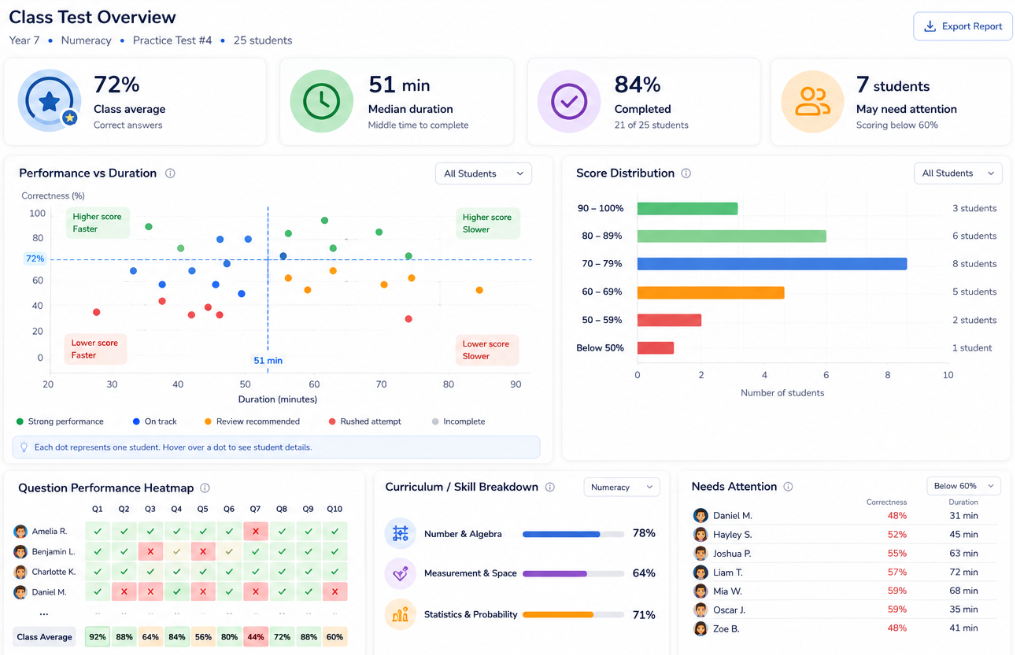
A mark out of thirty tells you a student got twelve wrong. It does not tell you which twelve, or whether they are twelve of the same thing. Every result breaks down by sub-skill and sorts weakest first, so “18 out of 30” becomes “fractions and time need work, comprehension is solid” - which is the version you can actually plan a week around.
Every question carries a worked solution written to the student, plus an explanation of why the tempting wrong answer was tempting. That second part is the useful one for a teacher: a distractor chosen by half the class is a misconception worth ten minutes on the board, not thirty individual corrections.
Because each sitting is a genuinely different paper, sittings are comparable over time. Practise in October and again in February and the difference is progress rather than familiarity.
Why it works in a classroom
Thirty students, thirty papers
Papers are assembled per student at the moment they start. Nobody is sitting next to a copy of their own paper, and there is no fixed version to leak.
Timed or untimed
Run it under test conditions, or untimed for a student who needs it. Extra time can be set per student, and the clock is server-side so it cannot be paused from the desk.
Built for every student
Adjustable text size, an on-screen calculator where the paper allows one, and papers that can be sat from another year level to revise or to stretch.
Bring it to your school before NAPLAN 2027
It's free - every student in your school, all four papers, no cost and nothing to cancel. We'll walk you through it and set your school up.
Set Up My School - Free Sample Test Talk to us